
Mercedes-Benz 12V Battery: A Comprehensive Guide (Referencing Owner’s Manual)
Navigating Mercedes-Benz ownership requires understanding the 12V battery system, detailed within your owner’s manual. Subscription services, like Mercedes Me Connect, can unexpectedly impact battery drain, as noted by user experiences.
Understanding the 12V Battery System
The Mercedes-Benz 12V battery is crucial for starting the vehicle and powering essential electrical systems, beyond just ignition. It supports components like lights, infotainment (MBux), and comfort features. Modern Mercedes vehicles utilize a dual-battery system – a 12V and a high-voltage battery – but this section focuses specifically on the 12V component.
Understanding its role is vital, especially considering potential issues like parasitic drain, highlighted in online forums. Users report unexpected battery depletion, sometimes linked to activated subscriptions like Mercedes Me Connect, which experienced a significant price increase recently. The owner’s manual provides detailed specifications and operational guidance. It’s important to note that the battery management system (BMS) plays a key role in optimizing battery life and performance, and proper registration after replacement is essential for correct functionality. Remote key functionality, including unlocking, can also be affected by battery health, as experienced by some owners.
Battery Location and Access
The location of the 12V battery in your Mercedes-Benz varies depending on the model. Generally, it’s found under the hood, but some models, particularly newer ones, may house it in the trunk or even under the rear seats. Always consult your owner’s manual for the precise location specific to your vehicle.

Accessing the battery typically involves lifting a hood release lever inside the car and then securing the hood with its prop rod. Once open, the battery is usually visible, though it may be covered by a plastic shield that needs to be removed. Be mindful of potential obstructions and ensure you have adequate space to work. Remember that disconnecting or replacing the battery can affect electronic settings, necessitating battery registration – a process detailed in the owner’s manual and often requiring diagnostic tools. Issues with remote key functionality, as reported by users, can sometimes be linked to battery-related electrical system disturbances.
Battery Specifications & Types
Mercedes-Benz vehicles utilize various 12V battery types, primarily Absorbed Glass Mat (AGM) batteries. Your owner’s manual will specify the exact Group Size, Cold Cranking Amps (CCA), and Amp-Hour (Ah) rating required for your specific model and engine. Using the incorrect specifications can lead to performance issues or damage to the vehicle’s electrical system.
AGM batteries are preferred for their durability, low maintenance, and ability to withstand frequent cycling. However, some older models may use conventional flooded lead-acid batteries. It’s crucial to replace the battery with the type recommended in your owner’s manual. Furthermore, the battery management system (BMS) requires proper registration of the new battery, a process outlined in the manual, to ensure optimal charging and longevity. Unexpected battery drain, as experienced by some owners with Mercedes Me Connect subscriptions, highlights the importance of a correctly specified and functioning battery.
Checking the 12V Battery’s Condition
Regularly assessing your Mercedes-Benz 12V battery’s health is vital for preventing unexpected breakdowns. Your owner’s manual doesn’t detail specific visual checks, but observing for physical damage – corrosion around terminals, swelling, or leaks – is a good starting point. Pay attention to any slow engine cranking, dimming headlights, or unusual electrical behavior, as these can indicate a weakening battery.
Furthermore, be mindful of potential parasitic draws, which can deplete the battery even when the vehicle is off. Issues with Mercedes Me Connect subscriptions, as reported by users, can contribute to this. A professional battery test using a voltmeter (detailed in the following section) provides a more accurate assessment. Remember, a battery nearing the end of its life may exhibit seemingly random electrical glitches, potentially affecting remote key functionality, as some owners have experienced with unlocking issues.
Using a Voltmeter for Battery Testing
Employing a voltmeter offers a precise method for evaluating your Mercedes-Benz 12V battery’s state of charge. Begin by ensuring the vehicle is switched off and has been undisturbed for at least a few hours to allow for a stable reading. Set your voltmeter to the DC voltage setting, typically 20V. Carefully connect the red (positive) lead to the positive battery terminal and the black (negative) lead to the negative terminal.
A fully charged battery should register approximately 12.6 volts or higher. Readings below 12.4 volts suggest a partial charge, while anything below 12.0 volts indicates a significantly discharged battery. Remember that surface charges can skew initial readings; briefly applying a small load (e.g., turning on interior lights) and then retesting can provide a more accurate result. Be cautious when working around the battery, and always refer to your owner’s manual for any specific safety guidelines related to electrical components.
Interpreting Voltage Readings
Decoding your voltmeter readings is crucial for assessing your Mercedes-Benz 12V battery’s health. A consistent reading of 12.6V or higher signifies a fully charged and healthy battery, capable of reliably starting your vehicle. Values between 12.4V and 12.6V indicate a good charge, but monitoring is advised. Readings dipping below 12.4V suggest a partial discharge, potentially impacting starting performance, especially in colder weather.
A voltage below 12.0V signals a significantly discharged battery, likely requiring a charge. Repeatedly low readings, even after charging, may indicate a failing battery or an underlying issue like parasitic drain. Remember that voltage is just one indicator; a healthy voltage doesn’t guarantee sufficient cranking amps. Consult your owner’s manual for specific voltage thresholds relevant to your Mercedes-Benz model and consider professional testing for a comprehensive assessment. Unexpected battery drain, as experienced by some users with Mercedes Me Connect, should also be investigated.
Jump Starting Procedures (Owner’s Manual Guidance)
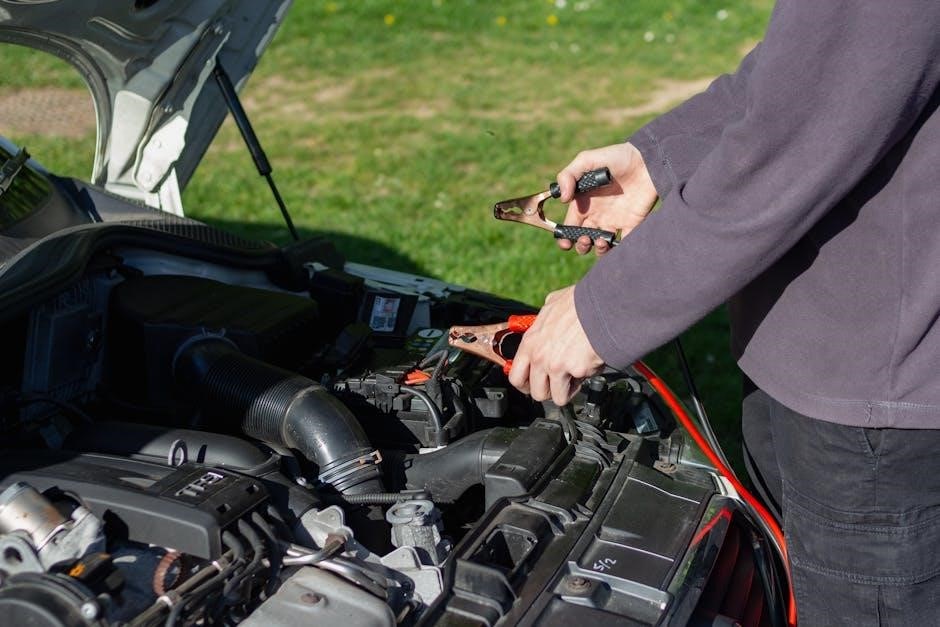
When facing a discharged battery, your Mercedes-Benz owner’s manual provides crucial jump-starting guidance. Always prioritize safety; wear eye protection and ensure both vehicles are switched off. Connect the red (positive) cable to the positive terminal of the discharged battery, then to the positive terminal of the assisting battery. Next, connect the black (negative) cable to the negative terminal of the assisting battery. Crucially, connect the final black cable to a grounded metal part of the disabled Mercedes-Benz engine block – not directly to the negative terminal.
Start the assisting vehicle and let it run for a few minutes. Then, attempt to start the Mercedes-Benz. If it doesn’t start immediately, allow the assisting vehicle to run longer. Once started, disconnect the cables in the reverse order of connection. Be mindful of potential subscription service impacts on battery drain, as reported by some owners. Refer to your manual for model-specific instructions and warnings.
Correct Jump Start Cable Connections
Establishing the correct jump start cable connections is paramount for safety and preventing damage to your Mercedes-Benz’s electrical system. Begin by firmly attaching the red (positive) clamp to the positive (+) terminal of the discharged battery. Then, connect the other red clamp to the positive (+) terminal of the assisting vehicle’s battery. Next, secure the black (negative) clamp to the negative (-) terminal of the assisting vehicle’s battery.

Critically, the final black clamp should not connect directly to the negative terminal of the discharged Mercedes-Benz battery. Instead, attach it to a clean, unpainted metal surface on the engine block, away from the battery. This minimizes the risk of sparks igniting hydrogen gas potentially released by the battery. Double-check all connections for secure contact before proceeding. Incorrect connections can cause serious electrical damage and potentially injure you. Always consult your owner’s manual for specific guidance related to your vehicle model.
Safety Precautions During Jump Starting
Jump starting a Mercedes-Benz requires strict adherence to safety precautions to prevent injury or vehicle damage. Always wear safety glasses to protect your eyes from potential sparks or battery acid. Ensure both vehicles are turned off before making any connections. Avoid smoking or using open flames near the batteries, as hydrogen gas is flammable.
Crucially, never allow the vehicles to touch each other during the jump start process. Confirm the assisting vehicle’s voltage matches your Mercedes-Benz’s system (typically 12V). If using a portable jump starter, follow the manufacturer’s instructions precisely. After the jump start, allow both vehicles to run for several minutes to recharge the batteries. Be mindful of potential subscription service impacts on battery drain, as reported by Mercedes-Benz owners. Refer to your owner’s manual for model-specific safety guidelines and warnings. Prioritize safety above all else.
Battery Maintenance & Care
Proactive battery maintenance extends the lifespan and reliability of your Mercedes-Benz’s 12V system. Regularly inspect the battery terminals for corrosion, a common issue exacerbated by varying climates; Keeping the terminals clean ensures optimal electrical conductivity and prevents starting problems. Your owner’s manual details the recommended cleaning procedures, typically involving a baking soda and water solution.
Furthermore, be aware that subscription services, like Mercedes Me Connect, can contribute to increased battery drain, potentially shortening its life. Periodically check the battery’s voltage using a voltmeter (refer to the “Checking the 12V Battery’s Condition” section). Avoid excessive short trips, as they may not allow the alternator sufficient time to fully recharge the battery. Proper care, combined with awareness of potential parasitic draws, will help maintain a healthy and dependable 12V system, as outlined in your vehicle’s documentation.
Cleaning Battery Terminals
Corrosion on the battery terminals hinders electrical flow, potentially leading to starting issues or system malfunctions. Your Mercedes-Benz owner’s manual provides specific guidance, but a common method involves disconnecting the battery (following safety precautions!), and creating a solution of baking soda and water. Apply this mixture to the terminals, allowing it to fizz and loosen the corrosion.
Afterward, thoroughly rinse with clean water and dry with a clean cloth. Applying a terminal protectant spray can help prevent future corrosion. Remember that subscription services, like Mercedes Me Connect, can contribute to battery drain, potentially accelerating corrosion due to increased cycling. Regularly inspecting and cleaning the terminals – ideally every six months – is a simple yet effective maintenance step. Always consult your manual for Mercedes-specific recommendations and safety guidelines before undertaking this task.
Preventing Corrosion on Terminals
Proactive measures significantly reduce terminal corrosion, extending your Mercedes-Benz 12V battery’s lifespan and ensuring reliable starting. After cleaning the terminals (refer to your owner’s manual for detailed instructions), applying a dedicated battery terminal protectant spray creates a barrier against moisture and corrosive elements. These sprays are readily available at automotive stores.
Regular inspection is crucial; even with protectant, check terminals every few months for early signs of corrosion. Addressing minor buildup promptly prevents it from escalating. Be mindful that frequent battery drain, potentially caused by services like Mercedes Me Connect or parasitic draws, can accelerate corrosion due to increased chemical reactions. Ensuring all connections are tight also minimizes corrosion risk. Finally, avoid using abrasive materials during cleaning, as they can damage the terminals and promote future corrosion. Consistent care, guided by your owner’s manual, is key.

Battery Replacement: Step-by-Step
Replacing your Mercedes-Benz 12V battery requires careful attention to detail; always consult your owner’s manual for vehicle-specific instructions. First, ensure the ignition is off and disconnect the negative terminal before the positive. This prevents accidental short circuits. Carefully remove the battery hold-down clamp. Lift the old battery straight up and out, avoiding any tilting that could spill acid.
Before installing the new battery, thoroughly clean the battery tray and terminals. Position the new battery correctly, ensuring proper polarity. Secure the hold-down clamp. Reconnect the positive terminal first, then the negative. Crucially, battery registration/coding is essential (see dedicated section) as the Battery Management System (BMS) needs to recognize the new battery’s specifications. Failure to register can lead to charging issues and reduced battery life. Remember, subscription services like Mercedes Me Connect can contribute to battery drain, so a new battery is a good preventative measure.
Disconnecting the Old Battery
Prior to disconnecting the old 12V battery in your Mercedes-Benz, consult your owner’s manual for specific guidance related to your model. Begin by ensuring the ignition is completely switched off. Locate the battery – its position varies by vehicle. Using the correct size wrench, carefully loosen the nut on the negative (-) terminal. Important: Disconnect the negative terminal first to prevent accidental short circuits.
Then, loosen and disconnect the positive (+) terminal. Gently remove any hold-down clamps securing the battery in place. Lift the battery straight up, being mindful of its weight and potential for acid spillage. Avoid tilting. Note any corrosion present on the terminals or cable connectors, as this indicates potential issues. Remember that issues with remote keys, as reported by users, can sometimes be battery related, but disconnecting the main battery is a necessary step for replacement.
Installing the New Battery
Carefully lower the new 12V battery into the battery compartment, ensuring it’s oriented correctly. Reinstall any hold-down clamps to secure it firmly in place. Connect the positive (+) terminal first, tightening the nut securely. Then, connect the negative (-) terminal, again ensuring a tight connection. Crucially, double-check that the terminals are connected with the correct polarity – reversing them can cause severe damage to the vehicle’s electrical system.
After connecting the terminals, inspect for any signs of corrosion on the connectors and clean them if necessary. Refer to your owner’s manual for specific torque specifications for the terminal nuts. Remember that a battery replacement often necessitates a battery registration/coding procedure, as the Battery Management System (BMS) needs to recognize the new battery’s characteristics. Issues with remote key functionality, as some users have experienced, might require addressing after a battery change, but proper installation is the first step.
Battery Registration/Coding (Important!)
Following a battery replacement in your Mercedes-Benz, battery registration, or coding, is absolutely essential. The vehicle’s Battery Management System (BMS) needs to learn the characteristics of the new battery – its capacity, voltage, and internal resistance – to optimize charging and prevent premature failure. Without this process, the BMS may incorrectly assess the battery’s state of charge, leading to various electrical issues.
Your owner’s manual details the recommended procedure, which often involves using a compatible diagnostic tool. These tools allow you to access the BMS and input the new battery’s specific data. Failure to register the battery can result in reduced battery life, inaccurate range estimations (in hybrid models), and potential malfunctions with start-stop systems. Some users have reported issues with Mercedes Me Connect functionality after a battery change, highlighting the importance of a correctly registered battery for overall system stability.
Why Battery Registration is Necessary
Mercedes-Benz vehicles utilize a sophisticated Battery Management System (BMS) that requires ‘learning’ when a new 12V battery is installed. This isn’t simply a matter of providing power; the BMS needs to recognize the new battery’s specific parameters – its Ampere-hour (Ah) capacity, voltage curve, and internal resistance. Without registration, the BMS operates based on the old battery’s profile, potentially leading to overcharging or undercharging.
Overcharging shortens battery life significantly, while undercharging can cause starting issues and strain other electrical components. The owner’s manual emphasizes this process, as it directly impacts the functionality of features like the auto start/stop system and accurate battery state-of-charge displays. Furthermore, issues with remote key functionality, as reported by some owners, can sometimes be traced back to an improperly registered battery. Correct registration ensures optimal performance and prevents unexpected electrical problems, safeguarding your vehicle’s systems.
Using Diagnostic Tools for Registration
Successfully registering a new 12V battery in your Mercedes-Benz typically requires a compatible diagnostic tool. While some advanced owner’s manuals might briefly mention the process, it generally necessitates a professional-grade scanner capable of accessing the Battery Management System (BMS). These tools allow you to input the new battery’s Ah capacity directly into the vehicle’s computer.
Commonly used diagnostic interfaces include those from iCarsoft, Autel, or the official Mercedes-Benz Xentry system. The process involves navigating to the battery registration section within the diagnostic software and following the on-screen prompts. It’s crucial to enter the correct Ah value, as an incorrect entry will negate the benefits of registration. If you’re uncomfortable performing this step yourself, the Mercedes-Benz Customer Assistance Center (CAC) or a qualified technician can assist, ensuring proper BMS adaptation and preventing potential electrical issues.
Mercedes-Benz Battery Management System
The Mercedes-Benz Battery Management System (BMS) is a sophisticated electronic system integral to the vehicle’s electrical architecture. It continuously monitors the 12V battery’s state of charge, voltage, and current flow, optimizing charging cycles for longevity and performance. Your owner’s manual will likely allude to the BMS’s role, but detailed explanations are often limited.
The BMS adapts the charging profile based on battery age, usage patterns, and temperature, preventing overcharging or deep discharge. Crucially, it requires ‘registration’ or ‘coding’ when a new battery is installed to inform the system of the battery’s specific characteristics (Ah capacity). Failure to register a new battery can lead to suboptimal charging, reduced battery life, and even electrical system malfunctions. Issues with subscription services, like Mercedes Me Connect, can also contribute to unexpected battery drain, highlighting the BMS’s importance in overall system health.
Understanding the BMS Functionality
The Mercedes-Benz Battery Management System (BMS) goes beyond simple charging; it’s a proactive system designed to maximize 12V battery lifespan and reliability. It actively manages power distribution, prioritizing critical systems during low-voltage situations and preventing parasitic drains. Referencing your owner’s manual will confirm the BMS’s presence, though detailed operational specifics are often reserved for technical documentation.
A key function is adaptive charging – the BMS learns your driving habits and adjusts charging accordingly. It also monitors individual battery cells, detecting imbalances that could indicate a failing battery. Furthermore, the BMS communicates with other vehicle systems, like the engine control unit, to optimize energy consumption. User reports suggest unexpected battery drain can occur with services like Mercedes Me Connect, potentially triggering BMS interventions. Proper battery registration after replacement is vital for the BMS to function correctly, ensuring optimal performance and preventing premature failure.
Common 12V Battery Related Issues

Mercedes-Benz vehicles, while renowned for engineering, aren’t immune to 12V battery problems. Frequent battery drain is a commonly reported issue, often linked to the vehicle’s complex electronics and subscription services like Mercedes Me Connect, which have seen significant price increases, potentially impacting battery load. Remote key functionality can also falter, with users reporting keys failing to unlock the car or trunk even after battery replacement – a fuse check is a first step, as outlined in owner’s manuals.
Another prevalent concern is electrical parasitic draw, where systems continue to consume power even when the vehicle is off. This can slowly deplete the battery, leading to starting problems. Addressing this often requires diagnostic tools to pinpoint the offending circuit. Furthermore, older C-Class models (like the C43) can experience issues, and owners advise purchasing original, unmodified vehicles to avoid complications. Always consult your owner’s manual for specific troubleshooting steps and recommended battery types.
Frequent Battery Drain Problems
Mercedes-Benz owners frequently encounter issues with rapid battery discharge, often stemming from the vehicle’s sophisticated electronic systems. A significant contributor appears to be the Mercedes Me Connect service, with reported cost increases potentially correlating with heightened battery strain. Users have noted substantial price jumps for subscription renewals, raising concerns about the system’s power consumption. Furthermore, the vehicle’s always-on features, designed for convenience and security, contribute to a constant, albeit small, drain.
Parasitic draw, where components continue operating even when the ignition is off, is another common culprit. This can manifest as a consistently dead battery, requiring frequent jump starts. Remote key issues, such as failure to unlock the car despite new batteries, can also indicate a deeper electrical problem. Referencing your owner’s manual is crucial for understanding your vehicle’s specific systems and identifying potential sources of drain. Contacting the Mercedes-Benz Customer Assistance Center can also help resolve unexpected service deactivations.
Addressing Electrical Parasitic Draw

Identifying and resolving parasitic draw in your Mercedes-Benz requires a systematic approach, often best undertaken with professional assistance. Begin by consulting your owner’s manual for fuse box diagrams and component locations. A common starting point is checking the fuses, though a faulty fuse is rarely the sole cause. Disconnecting components one by one, while monitoring current draw with an ammeter, is a more effective, albeit time-consuming, method.

Focus on recently installed aftermarket accessories, as these are frequent sources of parasitic drain. The Mercedes-Benz Customer Assistance Center (CAC) can assist with unexpected service deactivations that might contribute to increased electrical load. Remember that the complex electronic systems, including Mercedes Me Connect, are always drawing some power. If you’re uncomfortable performing these tests yourself, a qualified technician can accurately diagnose and repair the issue, preventing recurring battery drain and ensuring reliable vehicle operation.
Mercedes Me Connect & Battery Monitoring
Mercedes Me Connect offers remote vehicle status checks, including potential battery monitoring capabilities, though direct voltage readings aren’t typically displayed. Users have reported significant price increases for subscription renewals, highlighting the importance of reviewing costs. A consistently draining battery can be linked to these connected services, especially if there are software glitches or unexpected data usage.
Refer to your owner’s manual for specific details on how Mercedes Me Connect interacts with the vehicle’s electrical system. While the system doesn’t directly show battery voltage, it can alert you to issues preventing remote start or locking/unlocking, which could indicate a low battery. If you experience problems with remote key functionality, as some owners have, check the key fob battery first. Contacting the Mercedes-Benz Customer Assistance Center (CAC) is recommended if you suspect an improperly deactivated subscription is causing excessive drain.
Remote Battery Status Checks
While Mercedes Me Connect doesn’t typically provide a precise 12V battery voltage reading remotely, it offers indicators of potential issues. The app can confirm if remote functions – like door locking/unlocking or remote start – are operational. Failure of these functions often signals a low battery charge, prompting investigation. However, it’s crucial to understand this is an indirect assessment, not a direct voltage measurement.
Your owner’s manual details the limitations of remote monitoring. It’s essential to remember that Mercedes Me Connect relies on the vehicle’s systems to report status; it doesn’t independently assess the battery. If you encounter problems with the remote key, first replace the battery within the fob. Recurring issues, even after battery replacement, suggest a deeper problem. Contacting the Mercedes-Benz Customer Assistance Center (CAC) can help resolve subscription-related problems potentially impacting battery drain and remote functionality.
Troubleshooting Remote Key Issues (Battery Related)
A common symptom of a weakening 12V battery is the failure of the remote key to unlock the car or trunk, while still functioning for locking. As reported by Mercedes-Benz owners, this issue often persists even after replacing the battery within the key fob itself. This discrepancy points to insufficient vehicle battery power to operate the remote receiver.
Your owner’s manual recommends checking the relevant fuse (often the 8th fuse) if the remote key malfunctions. However, a good fuse doesn’t guarantee a solution; a low battery can still cause intermittent or complete failure. If the key’s unlock button doesn’t illuminate the red LED, it further suggests a vehicle-side power issue. Before assuming a key fob problem, verify the 12V battery’s condition using a voltmeter, as detailed in the owner’s manual. Contacting the Mercedes-Benz Customer Assistance Center can also help diagnose subscription-related issues potentially interfering with key functionality.
Key Fob Battery Replacement
While a failing 12V battery can mimic key fob issues, a depleted battery within the fob itself is a frequent cause of remote malfunction. Owners experiencing unlocking or locking problems should first address the fob’s power source. Although seemingly simple, proper battery replacement is crucial for continued operation.
Consult your Mercedes-Benz owner’s manual for the specific battery type required for your key fob model. Typically, these fobs utilize a CR2032 button cell battery. Carefully open the fob casing (often requiring a small screwdriver or specialized tool) and replace the old battery with a new one, ensuring correct polarity. After replacement, test all fob functions – lock, unlock, panic – to confirm proper operation. Remember that even with a fresh fob battery, a weak vehicle 12V battery can still hinder performance, particularly range and responsiveness. If issues persist, investigate the vehicle battery’s health.